
After years of being untouchable in Cambodia, the world’s most powerful scam boss has finally been arrested. This is the inside story of his rise, empire, and the geopolitical forces that brought him down.
On January 7, 2026, Chinese authorities arrested Chen Zhi, owner of the Prince Group and architect of what may be the largest cybercrime operation in history. The arrest sent shockwaves through Cambodia’s criminal underworld and the global cybersecurity community.
The scale is almost incomprehensible: an estimated $75 billion in cryptocurrency pig butchering scams over the past decade, $100 million in daily transaction volume, and a criminal infrastructure that rivaled legitimate financial institutions. Chen Zhi didn’t just run scam operations—he built an empire that included banks, real estate holdings worth hundreds of millions, international subsidiaries, and protection from one of Southeast Asia’s most powerful political families.
Until he didn’t.
                    0:00

                        /0:36


                    1×
The Arrest No One Expected
Two days before his arrest, few believed Chen Zhi would ever face justice. Hun Sen, Cambodia’s de facto ruler for nearly four decades, had protected him for years. Within Cambodia’s Chinese community, rumors circulated that Hun Sen was Chen Zhi’s “godfather”—that Chen had effectively become Hun Sen’s adopted son, even taking the name “Hun Mazhi” in honor of the ruling family.
The protection seemed ironclad. In 2019, when Chinese authorities formally requested Chen Zhi’s arrest with solid evidence and RMB 20 billion in seized funds, Hun Sen refused. The investigation had reached the highest levels—reportedly receiving direct written instructions from Xi Jinping himself.
But on January 7, 2026, that protection evaporated.
Video footage released by China’s Criminal Investigation Bureau showed Chen Zhi in a blue prison uniform marked “Dongkan,” handcuffed and escorted by Beijing’s elite “Blue Sword Commando” SWAT team. The vehicle’s license plate indicated he was being taken to Dongcheng District Detention Center in Beijing—the same facility where China holds its highest-profile criminals.
What changed? The answer reveals the complex geopolitical chess game that ultimately brought down Cambodia’s scam emperor.
From Internet Cafes to Criminal Empire
The Legend of Mir Origins
Chen Zhi’s story begins in China’s Fujian province, where he dropped out of school and worked as an internet cafe manager in the early 2000s. He was, by most accounts, a petty hoodlum who recognized opportunity in the gray areas of China’s emerging digital economy.
His first “pot of gold” came from an unlikely source: Legend of Mir, a South Korean online game that became a nationwide phenomenon in China starting in 2001. The game’s popularity is difficult to overstate—in internet cafes across China, almost everyone played the same game. Its fantastical universe of mages casting lightning and Taoists summoning skeleton warriors captivated an entire generation of young Chinese men.
The game’s explosive growth propelled Chen Tianqiao, founder of Shanda Interactive (which operated Legend of Mir in China), to briefly become the country’s richest man. But when the game’s source code leaked, so-called “private servers” emerged—unauthorized, pirate versions running on independent servers.
These private servers existed in a legal gray zone: clearly illegal, yet extremely difficult to eradicate. They needed advertising to attract players, which gave rise to numerous advertising websites.
The Knight Group
According to Chinese media reports, a quasi-hacker group known as the “Knight Group” emerged during this period. Through hacking, they took control of numerous advertising agent websites, monopolized private-server ad placements, and quickly made 100 million yuan.
In 2011, Chongqing police cracked the case, arresting 19 suspects including ringleader Cai Wen. Another key suspect, Hu Xiaowei, escaped. Those arrested paid fines ranging from several million to tens of millions of yuan and received suspended sentences rather than prison time.
Multiple sources later confirmed to Chinese outlet Caixin that Chen Zhi was a member of the Knight Group, though he wasn’t among those arrested. It was around this time that Chen Zhi relocated to Cambodia.
Both Cai Wen and Hu Xiaowei are believed to have later joined him there, with ties to the Prince Group. According to Teo Kang Yeow Cliff, a Singaporean who managed parts of Prince Group’s business: “Hu Xiaowei is the person who brought Chen Zhi into the business, online gaming. He’s a ‘big brother,’ that’s what Chen always said.”
Evolution Into Online Gambling
Chen Zhi’s next move was crucial: he embedded gambling plug-ins into Legend of Mir private servers, marking his transition from gaming into online gambling.
A 2020 court judgment in Sichuan revealed that a company called “73 Network,” located in Prince’s Building in Phnom Penh, ran Legend of Mir private-server websites with built-in gambling features. Technical staff testified that multiple Prince Group companies were involved in setting up private servers with embedded gambling functions.
“Each company had its own boss,” the technicians said, “but in reality they all belonged to the same alliance, under the Prince Group.”
This structure would become the hallmark of Chen Zhi’s empire: not a single company, but a cluster of online gambling operators who banded together—mostly entrepreneurs from Fujian province—to form the Prince Group.
Other Fujian-run operations, somewhat smaller in scale, were pushed by competitive pressure from Prince to band together for survival, forming the Henghe Group—now Cambodia’s second-largest online gambling and scam syndicate, second only to Prince.
The Legitimization Strategy
Real Estate as Money Laundering
Among bosses operating in the gray economy of online gambling and romance scams, Chen Zhi made strategic choices that set him apart and gave his “business” far greater room to expand.
In 2011, Chen Zhi established Hengxin Real Estate, marking a strategic shift from online gambling into property. According to unverified reports, after holding a plot of land in Sihanoukville for just one year, he resold it at a USD 1.4 million premium. Three land transactions allegedly generated USD 15 million in profits.
What is indisputable: Prince Group acquired vast amounts of land in Cambodia and reaped enormous profits from the country’s soaring property prices. According to senior figures in Cambodia’s real estate industry, Prince purchased hundreds of hectares of land in northern Phnom Penh alone, now valued at several hundred million U.S. dollars.


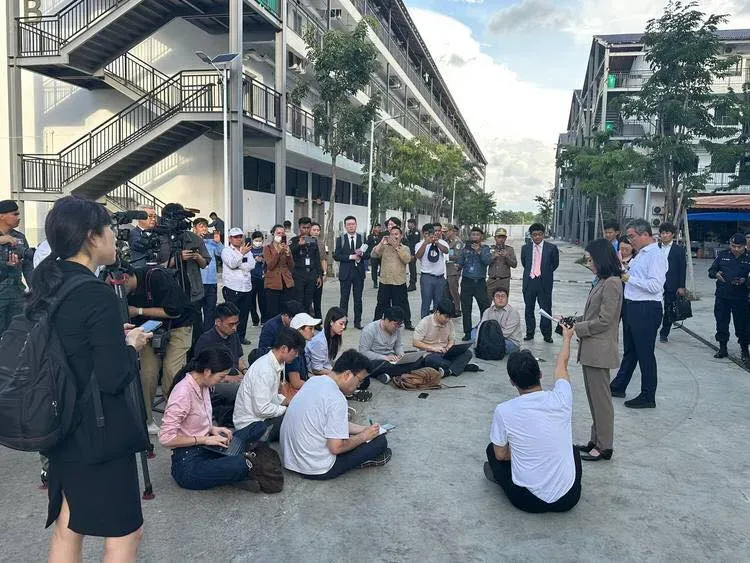
 Investigative journalist Huang Yan personally visited the area: “Most of this land remains undeveloped, with only a small portion used for a townhouse project known as One Tropica.”
Beyond capital appreciation, real estate offered something more important: legitimization. Cambodia’s skyrocketing land prices provided an effective channel to launder funds generated from gray-market activities. Prince Real Estate Group rebranded itself as a professional property developer operating openly in Cambodia.
A Chinese businessman who worked in Cambodia told Caixin that when Prince’s Phnom Penh real estate arm opened in 2013, the 26-year-old Chen Zhi appeared as the group’s general manager alongside several associates of similar age—all described as aggressive, risk-taking entrepreneurs from Lianjiang County, Fuzhou.
By 2015, Prince had moved from a small office into a large, full-floor corporate space. Among Phnom Penh’s elite, it was fashionable to use English names. Chen Zhi adopted “Vincent.” His image evolved from wearing jeans in the early days to donning tailored suits and designer belts.
The Banking License: The Critical Turning Point
Prince Group’s expansion reached a pivotal point in 2018 when it obtained a banking license—an outcome that surprised many in the local Chinese community.
“Everyone in Sihanoukville was fighting for it. Only two or three licenses were issued during that period,” a person familiar with the matter told Caixin. “Prince’s strength was clearly far beyond what outsiders understood.”
When journalist Huang Yan arrived in Cambodia in 2019, Prince Bank advertisements were everywhere. In tourist city Siem Reap and seaside town Kep, Prince Bank billboards lined both sides of roads—sometimes less than ten meters apart.
“At the time, I found it garish and couldn’t understand the purpose,” Huang Yan wrote. “In retrospect, Prince was using this overwhelming visibility to proclaim its victory—to signal to all of Cambodia that it had secured a banking license others could not.”
The banking license was Prince’s critical turning point. With Prince Bank, the group could conduct international transfers and cooperate with overseas banks, making it far easier to move funds generated from gray-market activities across borders. This marked the beginning of Prince’s expansion into other countries and regions.
Subsequently, Prince acquired:
- A cigar company in Cuba (establishing monopoly control)- Listed companies in Hong Kong and Singapore- Property in London (where Chen Zhi spent much time in recent years)- Significant assets in Japan- A Web 3.0 company based in Tokyo’s Roppongi district
One cryptocurrency industry figure claimed to have met Chen Zhi at a Tokyo barbecue restaurant, where Chen discussed his Web 3.0 product development. “He was very obsessed with the product,” she said. After dinner, they went to smoke cigars.
The Technical Infrastructure of a $75 Billion Operation
Phone Farms and Social Media Manipulation
The scale of Prince Group’s technical infrastructure was staggering. Documents from the US Eastern District of New York detailed facilities staffed with 1,250 mobile phones controlling 76,000 accounts on popular social media platforms.
These weren’t amateur operations. The phone farms represented industrial-scale social engineering capabilities, enabling Prince Group to:
- Run thousands of fake social media profiles simultaneously- Execute coordinated cryptocurrency fraud campaigns- Scale pig butchering scams to unprecedented levels- Maintain multiple personas per operator for maximum efficiency
The technical sophistication extended beyond simple phone farms. Prince Group developed or acquired:
Huione Payment System: According to a Chinese police officer involved in the investigation, Huione’s scale may have exceeded that of China’s Alipay. An estimated USD 100 million in funds flowed through these systems every day. The RMB 20 billion seized in 2019 represented only a small fraction of the total operation.
Cryptocurrency Infrastructure: Prince Group’s operations generated an estimated $75 billion in cryptocurrency pig butchering scams over 5-10 years. This wasn’t just investment fraud—it was systematic wealth extraction on a scale that rivaled nation-states.
International Banking Networks: With Prince Bank as the hub, the group could move money across borders through legitimate banking channels, making it nearly impossible for law enforcement to track funds without international cooperation.
The Compound Network
Prince Group’s formal businesses—banking and real estate—used the “Prince” name. But its gray-area scam operations used variations of the Chinese character “Jin” (金, meaning “gold” or “king”):
- Jinbei series of compounds in Sihanoukville- Jinyun compound in Chaitong- Jinhong compound on National Road No. 3 (also known as the Mango Compound)- Jinhe compound in Poipet- Multiple others across Cambodia and the border regions
These compounds housed thousands of workers—many trafficked against their will—who executed the scam operations. The “blood slave” cases that emerged from these facilities revealed horrific conditions: workers beaten, imprisoned, and in some cases having blood forcibly drawn for sale.
The Organizational Structure
Nine Kings and Thirteen Directors
According to sources close to the highest levels of Prince Group, the organization’s structure was more complex than a simple hierarchy:
Nine Core Shareholders: The Prince Group has nine true owners or core shareholders, each on roughly the same level as Chen Zhi. This wasn’t a dictatorship—it was an alliance of equals who recognized that cooperation multiplied their power.
Thirteen Directors: Beyond the nine shareholders, the group has 13 directors who wield considerable influence within the Prince system.
100+ Smaller Shareholders: The Prince empire absorbed numerous smaller shareholders brought in as partners during specific projects or compound development.
The result was a highly complex web: each shareholder controlled their own companies and subsidiaries, with extensive cross-shareholdings among them. This structure made it nearly impossible to dismantle the organization by arresting one person—even Chen Zhi himself.
Or so they thought.
Chen Zhi’s Leadership Style
“Chen Zhi is a very gentle person,” recalled a former senior executive at a Prince Group subsidiary. “I first met him at the Prince Club. I was very nervous, but he has strong personal charisma. The first thing he said to me was, ‘Are you tired?’ Instantly, I relaxed.”
“He’s extremely smart and very quick on his feet,” the executive added.
The same executive compared Chen Zhi with “Boss Xi,” owner of Huione: “Huione has a lot of money too, but Boss Xi doesn’t have Chen Zhi’s strategic thinking or big-picture vision. Compared with Prince, Huione’s business is still relatively single-track.”
“Boss Xi treats his subordinates well, like family. Chen Zhi may be a bit tougher—he expects his people to get things done, and to get them done well.”
This combination—personal charisma combined with strategic ruthlessness—enabled Chen Zhi to build an empire that operated simultaneously in the criminal underworld and legitimate business spheres.
The Journalists Who Paid the Price
The investigation into Prince Group wasn’t conducted by law enforcement alone. Brave journalists risked everything to expose the scam compounds and the human trafficking that enabled them.
Shen Kaidong: Arrested and Deported
Shen Kaidong, editor-in-chief of Angkor Today where journalist Huang Yan worked, was arrested by the Cambodian government and deported to China within 24 hours during the COVID-19 pandemic, when flights between Cambodia and China were extremely limited.
The immediate trigger was an article about corruption in COVID-19 vaccine procurement. But everyone knew the real reason: earlier reporting on online scam operations. Hun Sen’s assistant Dong Dara (now imprisoned on corruption charges), and the head of Cambodia’s National Security Bureau—Hun Sen’s son-in-law, Dy Vichea—had already summoned them for questioning.
“On the day the police came to arrest us, the editor-in-chief and I were both outside,” Huang Yan wrote. “I called him, and he said he was going back and wasn’t afraid of the police because they had come to check several times before.”
He never returned.
Chen Baorong: Ten Months in Prison
Chen Baorong, leader of a volunteer rescue team who helped hundreds of victims escape from scam compounds, was arrested by Cambodian police over the so-called “blood slave” case. He spent ten months in prison before being released on bail, then forced into silence.
The Cambodian government claimed Chen Baorong had fabricated “fake news” about the blood slave case. But Chen wasn’t even a journalist—he was a rescue volunteer. Before his arrest, the Cambodian government repeatedly insisted “there is no online fraud in Cambodia.”
Chen Baorong’s crime was making that lie impossible to maintain.
Mech Dara: Rescued by Diplomatic Intervention
Mech Dara, one of Cambodia’s most outstanding journalists covering scam compounds, was also imprisoned. Only after the British and U.S. ambassadors personally intervened and negotiated with Hun Manet (Hun Sen’s son and Cambodia’s current prime minister) was he released 20 days later.
When colleagues went to Kandal Province Prison to pick him up, they found dozens of journalists from international media waiting outside.
“We hugged, we cried,” Huang Yan wrote.
The Death Threats
After the U.S. and UK announced joint sanctions against Prince Group in 2025, Chen Zhi’s operations were hit hard. Furious and desperate for revenge, they turned on the Chinese journalists they could reach.
Through intermediaries, Huang Yan received word: if he appeared in Cambodia, they would deal with him using underworld methods—physical elimination.
“There are so many bodies in the Mekong River, no one will investigate who this one belongs to.”
Huang Yan was forced to cancel plans to return to Cambodia, even briefly. He continued reporting and writing from Bangkok, listening on loop to “A Cruel Angel’s Thesis,” the theme song from Neon Genesis Evangelion.
“The pounding music filled my ears, giving me the courage to keep reporting and writing with composure.”
The Geopolitical Perfect Storm
2019: Protected by Hun Sen
When Chinese authorities formally investigated Prince Group in 2019 with solid evidence and RMB 20 billion in seized funds, Hun Sen refused to cooperate. Within Cambodia’s Chinese community, people believed Prince was simply too powerful to be taken down.
“Everyone in Phnom Penh’s Chinese community heard that Hun Sen was Chen Zhi’s ‘godfather,’ and that Chen Zhi had effectively become Hun Sen’s ‘son,’ even adopting the name ‘Hun Mazhi,’” sources reported.
Hun Sen’s three biological sons all bear the name “Hun Ma-”: Hun Manet (now prime minister), Hun Manith (deputy army commander), and Hun Many (deputy prime minister). Adding “Hun Mazhi” to the family wasn’t just symbolic—it was a declaration of protection.
After surviving the 2019 arrest attempt, Chen Zhi and Prince Group appeared untouchable within Cambodia. People from Prince told journalists: “Cambodia will protect him to the end. The aid China gives Cambodia isn’t as tangible as the money our boss provides—so it won’t happen.”
They were trapped in an information bubble, clinging to naive assumptions.
2024-2025: The Walls Close In
What changed? Not one factor, but a perfect storm of international pressure:
United States Treasury Sanctions (2024): The U.S. Department of Treasury’s Office of Foreign Assets Control (OFAC) designated Prince Group and associated entities for human trafficking and forced labor. This wasn’t symbolic—it cut off Prince Group’s access to the U.S. financial system and any banks that wanted to do business with America.
“Prince has been seriously wounded this time,” said a source close to Prince-linked compounds. “It’s not mainly about the money. The real damage is that the entire system has been exposed. From now on, whatever they do, they’ll have to look over their shoulder.”
United Kingdom Joint Action (2024): The UK joined U.S. sanctions, creating coordinated Western pressure. For Cambodia—a country dependent on Western investment and tourism—this represented existential economic threat.
South Korean Pressure (2025): South Korea applied significant pressure by discouraging its citizens from traveling to Cambodia, effectively forcing Cambodian officials to lobby Seoul to ease restrictions. Eventually, several Prince-linked compounds heavily reported by South Korean media were investigated and cleared—something unprecedented.
These included the Brother Compound and Davis Hotel in Phnom Penh, as well as the Mango Compound and Mango 2 Compound on the capital’s outskirts. South Korean government delegations personally inspected facilities.
Thai Border Conflicts (2025): Scam operations spilling across the Thai-Cambodian border created diplomatic incidents. Thailand, another key ASEAN partner, began applying pressure.
Continued Chinese Pressure: Throughout 2024-2025, China maintained pressure through diplomatic channels, economic leverage, and public statements about combating online fraud.
The Brutal Calculation
By early 2026, Hun Sen and the ruling Hun family faced an impossible situation: simultaneously alienating both the U.S. and China—the world’s two major powers—while severely offending South Korea, Japan (both critical sources of tourists and investment), and Thailand.
The political calculus became clear: Cambodia’s ruling family faced the risk of regime collapse if they continued protecting Chen Zhi.
The decision was brutal but rational: cut off a limb to save the body. Sacrifice “Hun Mazhi” to preserve the Hun dynasty.
On January 7, 2026, Chen Zhi was arrested and put on a plane to Beijing.
What Happens Next?
The Power Vacuum
Chen Zhi’s arrest creates a massive power vacuum in Cambodia’s criminal ecosystem. The Prince Group wasn’t just one of many criminal organizations—it was the dominant force that shaped the entire landscape.
Several scenarios are possible:
Fragmentation: Without Chen Zhi’s leadership and strategic vision, the nine core shareholders and 13 directors may splinter into competing factions. This could lead to violent conflict as different groups fight for control of lucrative scam operations.
Henghe Ascendancy: The Henghe Group, Prince’s main competitor and Cambodia’s second-largest scam syndicate, may move to absorb Prince’s operations and territory. This could lead to a period of consolidation under new leadership.
Government Crackdown: Having sacrificed Chen Zhi to international pressure, the Cambodian government may need to demonstrate continued cooperation by cracking down on other scam operations. This seems less likely given the corruption that enabled these operations in the first place.
Migration to New Jurisdictions: Scam operators may flee Cambodia for other Southeast Asian nations with weaker law enforcement or more reliable protection. Myanmar, Laos, and certain regions of the Philippines remain potential safe havens.
The Precedent for International Cooperation
Chen Zhi’s arrest establishes a crucial precedent: even the most powerful, well-protected cybercriminals can be brought to justice when major powers coordinate pressure.
This case demonstrates that:
Economic sanctions work: The U.S. Treasury’s actions cut off Prince Group’s access to international financial systems, making continued operations untenable.
Multilateral pressure multiplies effectiveness: Coordinated action by the U.S., UK, South Korea, Thailand, and China created pressure no single nation could achieve alone.
Legitimate business ties create vulnerability: Chen Zhi’s strategy of building legitimate businesses to launder money and gain respectability backfired. Those legitimate ties created leverage points for sanctions and diplomatic pressure.
Political protection has limits: Even Hun Sen’s personal protection couldn’t withstand the combined pressure of multiple major powers threatening Cambodia’s economic and political stability.
Implications for Cybersecurity Professionals
For those of us in the cybersecurity consulting space, Chen Zhi’s arrest offers several lessons:
Scale matters in law enforcement: The $75 billion scale and the geopolitical implications were necessary to mobilize the level of international cooperation required. Smaller operations may not receive the same attention.
Follow the money, but also follow the legitimacy: Chen Zhi’s downfall came not just from tracking illicit funds, but from exposing how those funds were laundered through legitimate businesses and banking systems.
Technical infrastructure is evidence: The phone farms, the Huione payment system, the compound networks—all represented physical evidence that could be documented, photographed, and used to build international consensus about the scale of operations.
Journalist courage matters: Without the brave reporting of Huang Yan, Mech Dara, Chen Baorong, Shen Kaidong, and others who risked their lives to expose these operations, the international community might never have mobilized the political will to act.
Protection is never permanent: Organizations and individuals who believe they’re untouchable often make fatal miscalculations. Chen Zhi’s confidence in Hun Sen’s protection led him to expand operations to a scale that ultimately made him impossible to protect.
The Human Cost We Can’t Forget
Behind the billions of dollars, the phone farms, and the geopolitical maneuvering, we must remember the human cost:
- Thousands of workers trafficked into scam compounds- Victims beaten, imprisoned, and in some cases having blood forcibly drawn- Millions of scam victims worldwide who lost their life savings to pig butchering operations- Journalists imprisoned, threatened, and forced into exile for exposing the truth- Families destroyed by both the scam operations and the violence used to maintain them
When Huang Yan learned of Chen Zhi’s arrest, he wrote: “It was the happiest day of the year 2025 for me—smiling through tears. On my motorcycle back home, my tears were carried away by the wind in Bangkok’s streets.”
He added: “Now, perhaps, I am finally free.”
But he’s not planning to return to Cambodia immediately. “I still need time—to observe, to assess whether it’s truly safe.”
That caution is warranted. Chen Zhi may be in Beijing’s custody, but the Prince Group’s nine core shareholders, 13 directors, and 100+ smaller shareholders remain at large. The infrastructure that generated $100 million in daily transactions doesn’t disappear overnight.
Conclusion: A Watershed Moment
Chen Zhi’s arrest represents a watershed moment in the fight against transnational cybercrime. For the first time, we’ve seen coordinated international action successfully dismantle the protection surrounding a cybercrime operation of unprecedented scale.
But we must be realistic about what this means:
This is not the end of pig butchering scams. The techniques, the infrastructure, and the knowledge remain. Other operators will attempt to fill the vacuum.
This is not the end of scam compounds in Southeast Asia. Cambodia alone hosts numerous other operations, and neighboring countries continue to harbor similar facilities.
This is not the end of cryptocurrency fraud. The fundamental vulnerabilities that enable these scams—irreversible transactions, pseudo-anonymity, and regulatory arbitrage—persist.
What Chen Zhi’s arrest does prove is that accountability is possible when:
- Multiple nations coordinate pressure- Journalists risk everything to expose the truth- Law enforcement persists despite initial failures- Economic leverage is applied strategically- The human cost is documented and made impossible to ignore
For cybersecurity professionals, the message is clear: our work matters. The technical analysis, the threat intelligence, the patient documentation of criminal infrastructure—all of it contributes to the slow, difficult work of justice.
Chen Zhi built an empire over 15 years. It took nearly as long to bring him down. But he is down.
That’s progress.
Stay Informed About Cybercrime Trends
The Prince Group case demonstrates how quickly cybercrime operations can scale and how difficult they are to combat. Stay ahead of emerging threats:
Subscribe to ScamWatchHQ for in-depth analysis of cybercrime trends, scam techniques, and protective strategies. We monitor the evolving landscape so you don’t have to.
Sign up for ScamWatchHQ
Expert in scam prevention, cybersecurity insights, and protecting against fraud.
                Subscribe


            .nc-loop-dots-4-24-icon-o{--animation-duration:0.8s}
            .nc-loop-dots-4-24-icon-o *{opacity:.4;transform:scale(.75);animation:nc-loop-dots-4-anim var(--animation-duration) infinite}
            .nc-loop-dots-4-24-icon-o :nth-child(1){transform-origin:4px 12px;animation-delay:-.3s;animation-delay:calc(var(--animation-duration)/-2.666)}
            .nc-loop-dots-4-24-icon-o :nth-child(2){transform-origin:12px 12px;animation-delay:-.15s;animation-delay:calc(var(--animation-duration)/-5.333)}
            .nc-loop-dots-4-24-icon-o :nth-child(3){transform-origin:20px 12px}
            @keyframes nc-loop-dots-4-anim{0%,100%{opacity:.4;transform:scale(.75)}50%{opacity:1;transform:scale(1)}}


            Email sent! Check your inbox to complete your signup.
No spam. Unsubscribe anytime.
Sources:
- Caixin report: https://finance.caixin.com/2026-01-08/102401503.html- OCCRP investigation: https://www.occrp.org/en/scoop/multiple-identities-reveal-ties-between-chinese-businessman-and-cambodian-criminal-conglomerate- The Times: https://www.thetimes.com/world/asia/article/chinas-romance-scam-billionaire-ran-web-of-fraud-from-britain-tz9w5v258- Cambodia: Rain and Dust (Huang Yan’s Substack)- US Eastern District of New York court documents- Phoenix Weekly
Have you or someone you know been targeted by pig butchering or romance scams? Share this article to help others recognize the warning signs. Together, we can reduce the effectiveness of these operations.
There’s the complete article! Would you like me to adjust anything or create supporting content for social media promotion?