A second Reuters investigation reveals Meta’s calculated tolerance for billions in fraudulent advertising—and why this time, corporate deflection won’t be enough.
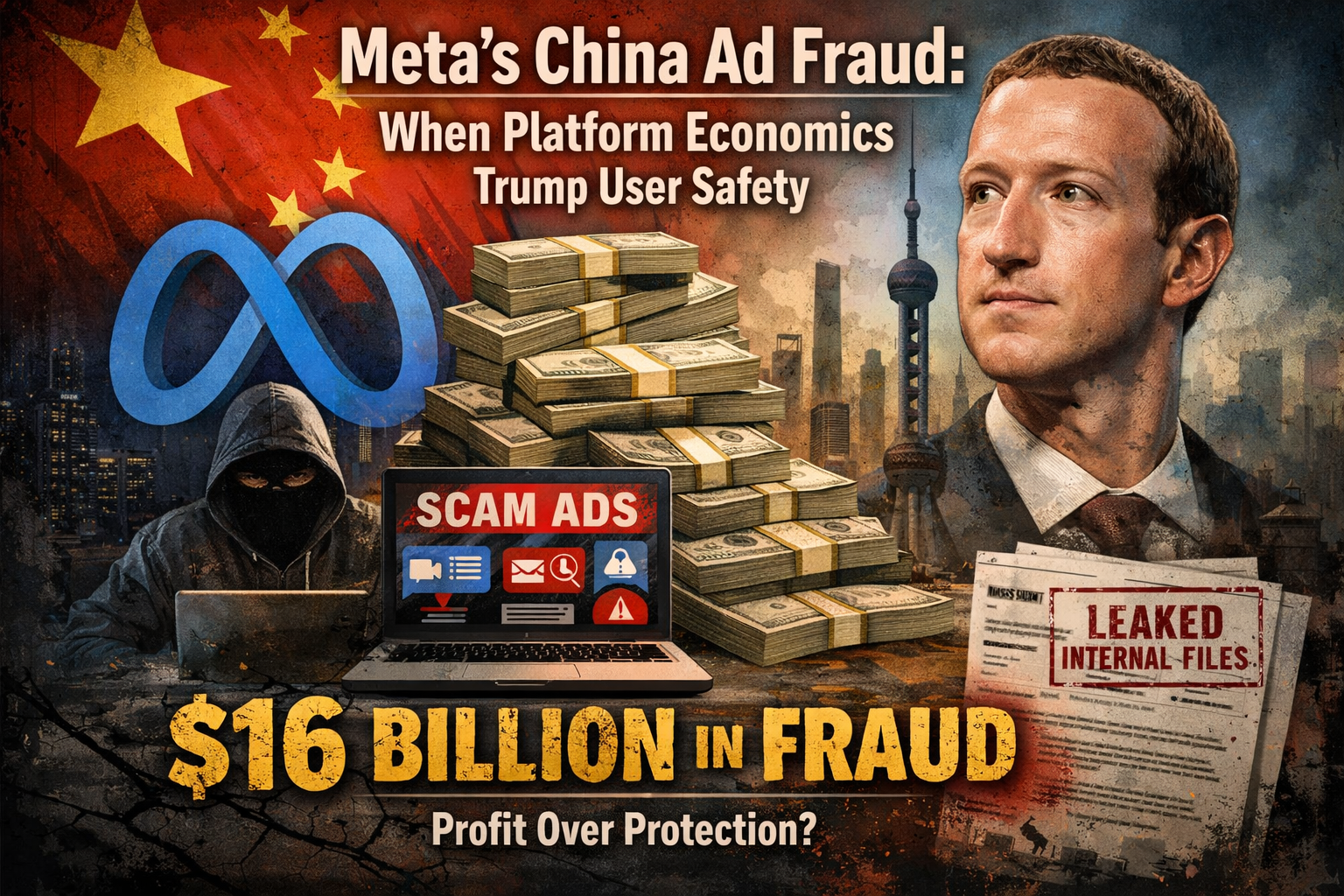
A few weeks ago at the Global Anti-Scam Summit (GASS), I had an opportunity for an on-stage conversation with a Meta executive about the damning Reuters report from October. That investigation, based on internal Meta documents, showed that approximately 10% of Meta’s $160 billion annual revenue—roughly $16 billion—flowed from paid scam advertisements.
I was initially heartened to see Meta willing to engage publicly on such serious allegations. But I was quickly disturbed by their defense strategy: essentially claiming that award-winning investigative reporter Jeff Horwitz had fundamentally misrepresented the facts from their own internal documents. (You can watch the exchange at the 4-hour, 39-minute mark here if you’re interested in corporate spin in real-time.)
This week, Horwitz published a second investigation. And it raises even more serious questions that will be substantially harder to write off with corporate boilerplate and carefully-coached executives.
Meta’s China Ad Fraud: The Compliance Nightmare Every CISO and GRC Professional Needs to UnderstandWhen your advertising platform’s internal documents reveal calculated tolerance for fraud, your third-party risk management framework just became woefully inadequate. As cybersecurity and compliance professionals, we spend considerable effort building frameworks to assess third-party risk, vendor due diligence processes, and controls to protect our organizations from fraud exposure. We review Compliance Hub WikiCompliance Hub
The China Revenue Problem
According to internal Meta documents reviewed by Reuters, the social media giant knowingly accepted billions of dollars in fraudulent advertising from China. The company calculated that roughly 19% of its $18 billion in annual China-linked ad revenue—more than $3 billion—came from advertisements for scams, illegal gambling, pornography, and other banned content.
Let me state that plainly: Meta’s own internal assessments concluded that $3 billion of their revenue was definitively fraudulent, and they made deliberate business decisions about how aggressively to address it based on “revenue impact.”
Here’s what happened, according to the documents:
- Meta created a specialized anti-fraud team in 2024 that successfully reduced problematic Chinese ads from 19% to 9% of total Chinese advertising revenue2. CEO Mark Zuckerberg intervened with what documents describe as an “Integrity Strategy pivot”3. The anti-fraud team was disbanded, the freeze on new Chinese ad agencies was lifted, and additional anti-scam measures that testing showed would be effective were shelved4. Fraudulent ads rebounded to 16% of China revenue by mid-2025
Meta spokesperson Andy Stone claimed the anti-fraud team was “always meant to be temporary” and that Zuckerberg’s directive was to “redouble efforts” globally. But the internal documents paint a different picture: a calculated retreat from enforcement when revenue was at stake.
Why This Matters Beyond Content Moderation
This isn’t simply another content moderation failure or a detection problem that better AI can solve. This matters for at least three distinct and serious reasons:
1. Scale & Intent: Deliberate Business Decisions About Tolerable Harm
This is not a failure of detection systems or a case of scammers outsmarting automated filters. According to the Reuters investigation, this represents a series of deliberate business decisions about how much consumer harm is acceptable when measured against revenue impact.
Consider these data points from Meta’s own internal documents:
- Meta’s systems blocked or removed 46 million ads from Chinese business partners over 18 months—evidence their detection capabilities function- The company calculated exact percentages of fraudulent revenue (19%, then 9%, then back to 16%)- In one February 2025 document, Meta managers explicitly stated the company would permanently tolerate elevated levels of misconduct from Chinese advertisers rather than seek “parity” with ad quality from the rest of the world- When enforcement teams proposed shutting down accounts generating $28 million in rule-violating ads, colleagues asked about “revenue impact” before proceeding, ultimately targeting only $2.8 million worth of the most egregious violators
This isn’t an engineering challenge. It’s a business model built around calculated tolerance for consumer harm when elimination would impact revenue.
2. China as a Scam Export Hub: Asymmetric Warfare Against Western Consumers
Meta’s internal documents reportedly describe China as its top “scam exporting nation,” responsible for roughly a quarter of all scam and banned-goods advertisements globally on Meta’s platforms. The victims range from shoppers in Taiwan purchasing bogus health supplements to investors in the United States and Canada swindled out of their life savings.
The geopolitical asymmetry here should alarm policymakers: Beijing bans its citizens from accessing Meta’s platforms while simultaneously allowing—and by inaction, enabling—Chinese companies to systematically exploit those same platforms to defraud consumers in other countries.
Meta’s documents note that China’s national holidays affect global fraud rates on Facebook and Instagram. During “Golden Week” in October, when hundreds of millions of Chinese citizens travel domestically, scam rates on Meta’s platforms decline worldwide. Think about the implications: China’s fraudulent advertising ecosystem is so dominant that its vacation schedule creates measurable global effects on Meta’s fraud metrics.
An external consultant hired by Meta—London-based Propellerfish—concluded that “the Chinese government does not interfere when violations target overseas audiences,” meaning crooked Chinese advertisers face “little or no risk” from their own government. The report also found that “Meta’s own behaviour and policies” were fostering systemic corruption in the Chinese market.
In March 2025, federal prosecutors announced the FBI had seized $214 million from promoters of one Chinese stock scam that used Facebook and Instagram ads to lure victims into WhatsApp groups run by “individuals in China posing as U.S.-based investment advisors.”
3. Systemic Features, Not Edge Cases: A System Optimized to Preserve Revenue
The Reuters investigation reveals that the problematic elements aren’t bugs in Meta’s system—they’re features of a business model optimized to preserve revenue even when that revenue demonstrably flows from consumer harm.
Consider Meta’s Chinese advertising infrastructure:
Opaque Reseller Networks: Meta sells most Chinese ads through 11 major agency partners who recruit smaller agencies, creating multiple layers of intermediaries that Meta admits make the system “impossible to closely police.” Some of these second-tier agencies operate outside China, violating Meta’s own stated policies.
Whitelisting Protections: Meta grants special “mistake prevention” status to top-tier agency accounts, meaning flagged ads remain active during secondary human review rather than being immediately removed. As one internal document notes: “Unfortunately the added time for secondary review is adequate for scammers to accomplish their objectives by gaining massive impressions.”
Penalty Fees Instead of Bans: When Meta discovered that more than half the ads from Beijing Tengze Technology—one of its top 200 advertisers globally, in the same league as American Express and BMW—violated its rules, it didn’t terminate the relationship. It charged the company higher fees as a “penalty.” (Meta claims it later cut ties; Beijing Tengze shut down early this year, and its listed headquarters address turned out not to exist.)
Calculated Tolerance Levels: Rather than eliminate fraud, Meta’s strategy became to “maintain the % of global harm” from China at current elevated levels—explicitly accepting that Chinese advertising will remain more problematic than advertising from other markets.
The Trust Problem Meta Can’t Spin Away
At GASS, Meta’s executive essentially argued that Reuters had misunderstood their internal documents and misrepresented their safety efforts. That defense strategy becomes exponentially harder with this second investigation, which includes:
- A commissioned external report (Propellerfish) explicitly stating Meta’s own behaviors enable fraud- Multiple internal documents showing enforcement retreats explicitly justified by “revenue impact”- Reuters journalists successfully placing banned ads through Meta’s “Badged Partners”—supposedly “trusted experts”—for as little as $30 in cryptocurrency- Documentation of Meta lifting enforcement freezes specifically to “unlock revenue”
If Meta’s internal assessments of fraud levels, enforcement effectiveness, and business decisions diverge this dramatically from their public assurances—and if enforcement demonstrably retreats when revenue is at stake—then several uncomfortable conclusions become unavoidable:
For Regulators: The case for recalibrated platform immunities under Section 230 grows substantially stronger when platforms knowingly profit from fraudulent advertising that harms consumers. This isn’t about controversial speech or difficult content moderation calls. This is about calculated business decisions regarding advertising fraud.
For Advertisers: Legitimate brands advertising on Meta’s platforms now have documented evidence that they’re competing for attention alongside systematic fraud operations that receive preferential protection from enforcement. The “brand safety” conversation just got significantly more complicated.
For Industry Partners: Banks, payment processors, and other entities in the trust and safety ecosystem should recognize that Meta has explicitly documented its tolerance for elevated fraud levels when enforcement would impact revenue. Partnership and data-sharing arrangements should account for this documented risk appetite.
For Lawmakers: When China can systematically exploit American platforms to defraud American consumers—while banning those same platforms from operating in China—and the platforms’ own documents show they calculated the harm but retreated from enforcement for revenue reasons, this becomes a national security conversation, not just a consumer protection issue.
The “Trust Us” Strategy Is Dead
I’m genuinely curious how Meta will respond to this second investigation. More importantly, I’m curious how regulators, advertisers, and industry partners will respond.
Because “trust us” is no longer a viable strategy when your own internal documents, reviewed by credible investigative journalists, show such a stark divergence between public safety commitments and private business decisions.
At GASS, Meta’s executive had the benefit of claiming misrepresentation of a single investigation. This second report—with commissioned external consultants reaching the same damning conclusions, with documented enforcement retreats explicitly tied to revenue concerns, with journalist-verified gaps in the “trusted expert” program—makes that defense substantially harder to maintain.
The pattern is clear: Meta has sophisticated systems capable of detecting fraudulent advertising. Meta can calculate the exact revenue flowing from fraud. Meta can successfully reduce that fraud when it chooses to deploy resources. And Meta explicitly retreats from enforcement when the revenue impact is deemed too high.
That’s not a content moderation problem. That’s a business model problem.
And it’s a problem that should concern everyone who interacts with digital advertising ecosystems, whether as consumer, advertiser, regulator, or partner. Because if platforms this large can knowingly tolerate billions in fraudulent revenue while assuring everyone they’re taking safety seriously, the entire trust architecture of digital advertising needs fundamental recalibration.
The only remaining question is whether that recalibration will be voluntary or imposed.